LEAD SHEET OF SAN ANDREU DE ULLASTRET
The Rosetta stone for deciphering Iberian found on the hill of San Andreu de Ullastret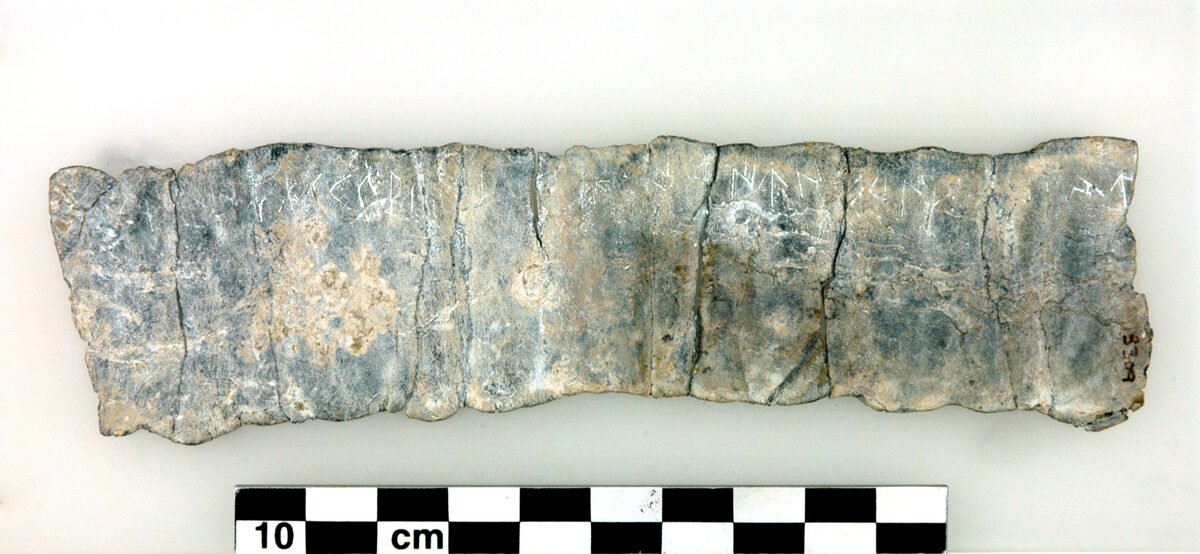
Imagine finding a message from another era, written more than two thousand years ago and engraved on a lead sheet.
A mysterious text, full of unknown characters, that has withstood the passage of time waiting to be deciphered. This is this Iberian letter. This piece, rectangular and irregular, had probably been rolled up in nine folds.
On one of its sides, six lines written in the northeastern Iberian alphabet can be distinguished, while on the other, only one line runs across its surface.
A complete commercial letter
This is one of the most complete inscriptions found to date. The text includes names and numerals, revealing the commercial context in which the Iberians interacted with the Greeks.
It is a commercial letter similar to the encounters in Empúries and the pre-Roman oppidum of Pech Maho, in Sigean, France.
This document is key to understanding Iberian culture, as it provides us with information about their alphabet, writing, and language. In fact, it is the largest set of Iberian inscriptions discovered so far.
Mysteries to solve
Although it has helped advance the understanding of these issues, there are still many mysteries to be solved.
It not only tells us about economic exchanges, but also narrates stories of a culture that, although read, still keeps its secrets.
Our Rosetta Stone? Not yet.
Although we can understand part of their language and writing, the true interpretation eludes us. The Iberian language remains an enigma, and experts are still searching for a kind of "Rosetta stone" that will allow us to decipher it completely.
It is not just an archaeological piece. Every new detail discovered brings us closer to unveiling the history of a culture that, although close, we still do not fully know.